Scientists See One of the Universe’s Largest Structures Taking Shape

Rutgers astronomers help identify 10 developing galaxy clusters from about 12 billion years ago
Using some of the world’s most powerful telescopes, scientists have peered nearly 12 billion years into the past and found one of the largest cosmic structures ever observed in the early Universe.
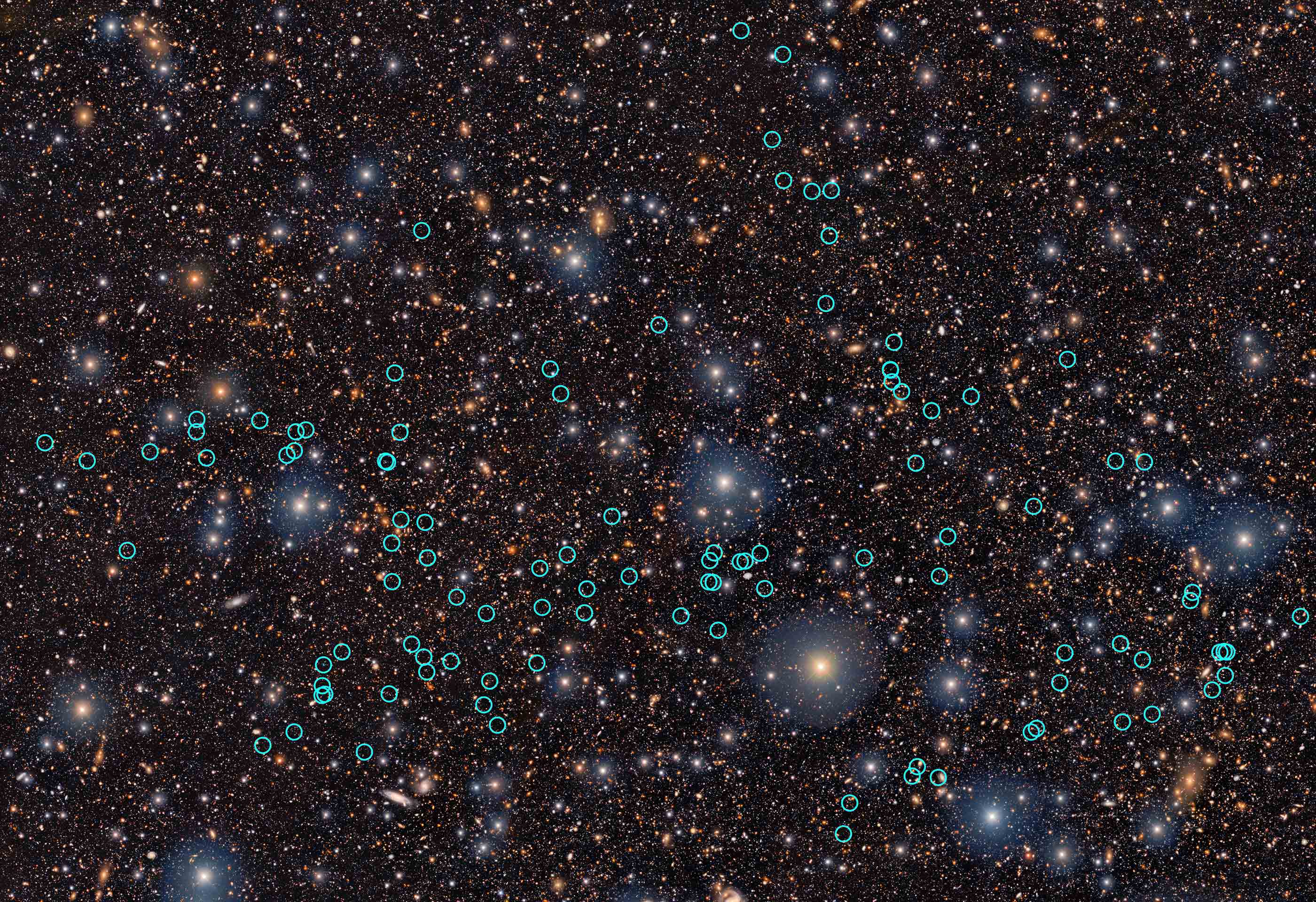
Seen as it existed when the universe was about 2.8 billion years old, the immense structure contained 10 dense groups of galaxies. Each was developing into a galaxy cluster, and together they were forming a vast collection of clusters known as a supercluster.
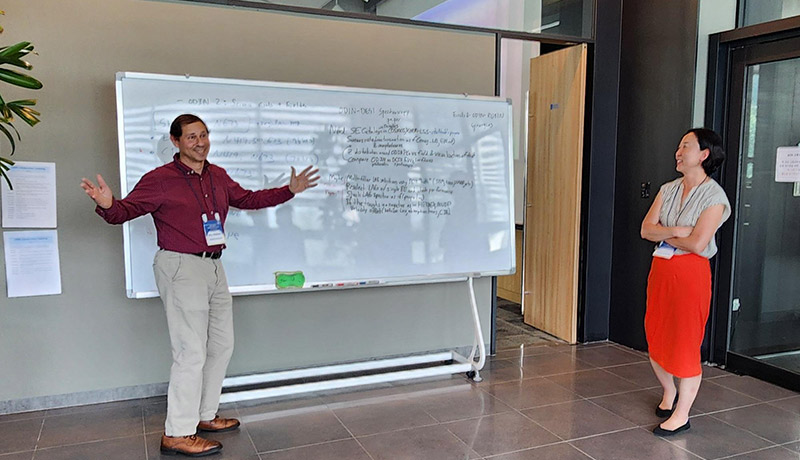
The findings were reported in The Astrophysical Journal by an international team that included Eric Gawiser, a Distinguished Professor in the Department of Physics and Astronomy at the Rutgers School of Arts and Sciences, and Nicole Firestone, a doctoral student in the Department of Physics and Astronomy.
By catching the structure while it was forming when the universe was relatively young, the finding offers scientists a rare opportunity to understand how modern galaxy clusters grew and evolved over time.
“When we look at galaxy clusters in the nearby universe, we are seeing the finished product,” Gawiser said. “This distant structure takes us back to a much earlier stage when the individual pieces were still coming together. It allows us to study how the universe built structures on its largest scales.”
The findings support the leading theory that the universe developed from the bottom up, Gawiser said. According to that theory, gravity pulled matter into small groups that joined over billions of years to create increasingly larger structures.
“When we look at galaxy clusters in the nearby universe, we are seeing the finished product,” Gawiser said. “This distant structure takes us back to a much earlier stage when the individual pieces were still coming together. It allows us to study how the universe built structures on its largest scales.”

Galaxy clusters are the universe’s largest structures held together by gravity. They can contain thousands of galaxies, span millions of light years and hold vast amounts of invisible dark matter. Dark matter can’t be seen directly, but scientists know it exists because of the gravitational pull it exerts on galaxies and other visible matter.
The distant structure, called COSMOS-z3.1-A, is a proto-supercluster, an early version of a large collection of galaxy clusters. It is the earliest, most distant proto-cluster ever found. Its estimated mass is 5,000 times that of the Milky Way, making it one of the most massive structures known from that period.
COSMOS-z3.1-A was first identified by the One-hundred-deg2 DECam Imaging in Narrowbands survey, known as ODIN. The international survey is led by Kyoung-Soo Lee, a Purdue University professor, and Gawiser.
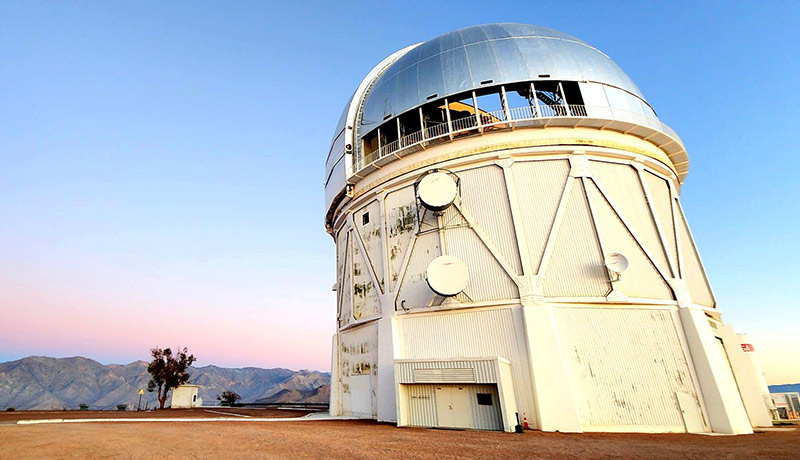
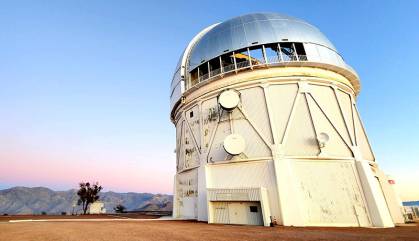
Using the Dark Energy Camera on the Víctor M. Blanco 4-meter Telescope in Chile, ODIN scientists identified about 150 distant proto-clusters that formed when the universe was about between 1 and 3 billion years old. Researchers focused on COSMOS-z3.1-A and a second structure, COSMOS-z3.1-C, because both contained unusually large concentrations of galaxies.
The initial images showed where the galaxies appeared in the sky but not their precise distances from Earth. Galaxies separated by enormous distances can appear beside one another because they line up from Earth’s point of view.
Firestone and other team members conducted follow-up observations to measure the galaxies’ distances and determine which belonged to the same structures.
“The first images told us that these regions of the Universe were exceptionally crowded with galaxies,” Firestone said. “By measuring the precise distances to these galaxies, we could confirm that they correspond to the same structures and reveal the true shapes of thos structures in 3D.”
The team used instruments on the Keck II and Gemini South telescopes in Hawai‘i, along with thousands of observations from the Dark Energy Spectroscopic Instrument on the Nicholas U. Mayall 4-meter Telescope in Arizona. Several ODIN researchers, including recent Rutgers graduate Govind Ramgopal, helped analyze the additional measurements.
Researchers combined precise distances for some galaxies with the larger collection identified in the original images. This allowed them to reconstruct the structures in three dimensions, including areas where individual distances hadn’t been measured.
The maps revealed 10 separate concentrations of galaxies in COSMOS-z3.1-A and four in COSMOS-z3.1-C. Both structures were clumpy, irregular and stretched across space, unlike the rounder, more settled galaxy clusters in the nearby universe.
The findings support the leading theory that the universe developed from the bottom up, Gawiser said. According to that theory, gravity pulled matter into small groups that joined over billions of years to create increasingly larger structures.
The researchers calculated that both distant structures would develop into structures more massive than the Coma Cluster, which is the largest galaxy cluster in the nearby universe.
COSMOS-z3.1-A appears to be exceptionally rare. The team found no comparable structure in the large computer simulation used to test its method.
“COSMOS-z3.1-A represents the most extreme, most overdense regions of the universe,” said Vandana Ramakrishnan, a Purdue doctoral student at the time of the research who led the study. “We think there should be fewer than one such object for every 10,000 galaxy clusters.”
Researchers expect to find more distant structures as the Vera C. Rubin Observatory begins its Legacy Survey of Space and Time. By repeatedly photographing much of the Southern Hemisphere sky, Rubin will produce observations that can be combined with ODIN data to trace the development of galaxy clusters across billions of years.
Explore more of the ways Rutgers research is shaping the future.