Did Impacts From Meteors Help Start Life on Earth?

Research synthesized by a recent Rutgers graduate suggests vents generated from the impacts of space rocks may have enabled suitable environments for the first living cells
Meteor impacts may have helped spark life on Earth, creating hot, chemical-rich environments where the first living cells could take shape, according to research integrated by a recent Rutgers University graduate.

“No one knows, from a scientific perspective, how life could have been formed from an early Earth that had no life,” said Shea Cinquemani, who earned her bachelor’s degree in marine biology and fisheries management from the Rutgers School of Environmental and Biological Sciences in May 2025. “How does something come from nothing?”
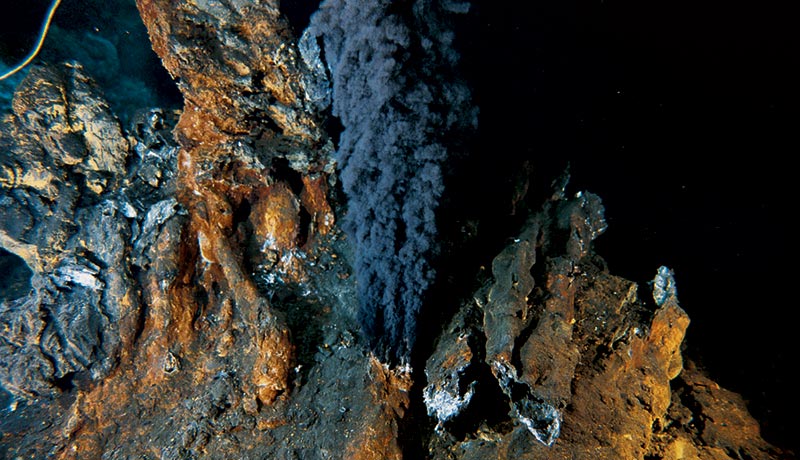
Cinquemani is the lead author of a scientific review, published in the peer-reviewed Journal of Marine Science and Engineering, examining where life may have first formed on Earth. The paper focuses on hydrothermal vents, places where hot, mineral-rich water flows through rock and emerges into surrounding water, creating the chemical conditions and energy gradients needed for complex reactions.
Her research points to hydrothermal systems created by meteor impacts as a potentially critical and underappreciated setting for the origin of life, strengthening the case beyond conventional deep-sea vent theories. Cinquemani said such systems would have been widespread on early Earth, making them especially compelling environments for life to begin.

The paper, co-authored with Rutgers oceanographer Richard Lutz, marks a rare achievement for a recent undergraduate whose work began as a class assignment and was transformed into a publication in a highly respected scientific journal.
“It’s amazing,” Lutz said. “You often have undergraduates that are part of papers – faculty choose undergraduates all the time to work on papers and projects. But for an undergraduate to be the lead author is a huge deal.”
The project started in the spring of Cinquemani’s senior year in a course called “Hydrothermal Vents,” taught by Lutz, a Distinguished Professor in the Department of Marine and Coastal Sciences. Cinquemani’s assignment was to examine whether hydrothermal vents on Mars could have been harbingers of life there.
“I was like, ‘I know nothing about this topic,’” she said. “Thinking about the origins of biology on another planet was like, whoa. Not sure how I’m going to do this.” The topic went beyond her usual comfort zone of biology and extended into chemistry, physics and geology, she said.
Cinquemani expanded the assignment after graduation into a full scientific review of both impact-generated and deep-sea vent systems, which was accepted after what Lutz described as a demanding peer-review evaluation.
“I have never seen such a rigorous review process,” Lutz said. “There were 15 pages of comments and five different rounds of reviews. She had the patience and perseverance, and the paper turned out magnificently.”

Deep-sea hydrothermal vents have long been considered a possible birthplace of life. Discovered in the deep ocean in the late 1970s, these systems host entire ecosystems that thrive without sunlight. Instead of photosynthesis, microbes use chemical energy from compounds released by vent fluids, such as hydrogen sulfide, in a process known as chemosynthesis.
Some deep-sea vents are powered by heat from the Earth’s interior near volcanic activity while others are driven by chemical reactions between water and rock that generate heat without magma. This heat facilitates chemical processes and provides a warm oasis in the otherwise barren seafloor of the deep ocean.
Cinquemani’s paper places more focus on a different category that has recently begun gaining attention: hydrothermal systems created by meteor impacts.
When a large meteor strikes Earth, the impact generates intense heat and melts surrounding rock. As the area cools and water fills the crater, a hot, mineral-rich environment can form, similar in some ways to deep-sea vents.
“You have a lake surrounding a very, very warm center,” Cinquemani said. “And now you get a hydrothermal vent system, just like in the deep sea, but made by the heat from an impact.”
To explore how these systems might support life, she examined research on three well-studied crater sites that span vastly different periods of Earth’s history. The oldest is the Chicxulub impact structure beneath Mexico’s Yucatán Peninsula, formed about 65 million years ago and later shown to have hosted a long-lived hydrothermal system. Next is the Haughton impact structure in the Canadian Arctic, formed about 31 million years ago. The youngest is Lonar Lake in India, created about 50,000 years ago, where the crater still contains water and offers clues about how these systems evolve over time.
These impact-generated systems may last thousands to tens of thousands of years, giving simple molecules time to form more complex structures that could lead to life.

Scientists say such environments may have been especially important on early Earth, which experienced frequent asteroid impacts. In that sense, events often seen as destructive also may have helped create the conditions for life.
The idea builds on decades of research into deep-sea vents while expanding the search for life’s origins into new territory.
Lutz helped explore these deep-sea environments several decades ago when they were still a scientific mystery. As a young postdoctoral researcher, he joined the first biological expedition to study hydrothermal vents and descended more than a mile beneath the ocean surface in the research deep-sea submersible Alvin, where he observed thriving communities of organisms in total darkness.
Those dives helped open a new field of research and shaped scientists’ understanding of how life can exist in extreme environments without sunlight.
“We have talked for many years about the possibility that life may have originated at deep-sea hydrothermal vents,” Lutz said.
Cinquemani’s work brings together those long-standing ideas with newer evidence that impact-generated systems also could play a role and may in some cases offer favorable conditions for early chemical reactions.
The implications extend beyond Earth. Hydrothermal activity is thought to exist on the ocean floors of icy moons such as Jupiter’s Europa and Saturn’s Enceladus, and may have existed in impact craters on young Mars. If these environments on Earth can support the chemistry of life, they could become key targets in the search for life elsewhere.
For Cinquemani, the work is driven by curiosity.
“Humans are insanely curious beings,” said Cinquemani, who works as a technician at Rutgers’ New Jersey Aquaculture Innovation Center in Cape May, N.J., where she supports aquaculture research while preparing to pursue advanced study in marine science. “We question everything. We may never know exactly how we began, but we can try our best to understand how things might have occurred.”
Explore more of the ways Rutgers research is shaping the future.