One Student’s Journey From a High School Summer Program to Graduate School

Thanks to PHocus, Lindsey Luper is pursuing her master of public health degree at Rutgers
In 2018, Lindsey Luper was a high school student interested in science and health, but she didn’t know much about public health.
Then one of her teachers told her about PHocus. Short for Public Health: Outbreaks, Communities, and Urban Studies, PHocus is a summer experience program for high school students offered through the Rutgers School of Public Health.
Luper signed up. Over the course of the program, she met Rutgers faculty and health professionals, visited various community organizations, learned about topics ranging from epidemiology to health communication, and started to see just how many different careers could fall under the public health umbrella.
She still remembers an activity from the last day of the program. Students used chalk to write what they had learned outside the school.
Luper’s group wrote four words: “Public health is everywhere.”
Eight years later, Luper is a master of public health student at the Rutgers School of Public Health, concentrating in social and behavioral health sciences. Her interests have become more specific – program development and evaluation, health communication, behavior change – but that early lesson about the reach of public health took root.
Over the summer, Luper was back at PHocus, this time as a graduate student, helping high school students explore some of the same questions she had been asking in 2018.
Luper discusses how her understanding of public health has changed since high school, what shaped her interests along the way, and what she hopes today’s PHocus students gain from their experience.
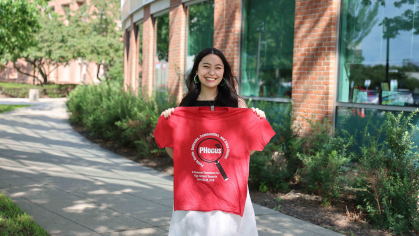
How did your early interest in public health shape what you studied in college?
When I was applying to Rutgers, public health was definitely something I was considering. I also applied to the pharmacy school, got in, and eventually began my journey there.
I spent just under two years in pharmacy and had some internship-type experiences in pharmacies. Those experiences helped me understand that I did not want to focus my career on clinical patient care.
I was interested in what happens before someone needs medication. How can we have an impact on someone’s health earlier? How can we affect the health of more people at once?
As you got older, what experiences started shaping the kind of public health work you were interested in?
My family has dealt with a few different health situations, and I’ve seen how much language and cultural background can affect someone’s experience with the health care system.
My mom’s side of the family emigrated from Hong Kong. They’ve been in the United States for a long time, but there are still things about the health care system here that have been difficult to navigate.
That made a lot of what we talk about in public health feel very real.
In one of my current program planning classes, we talk about questions like: What does this community value? What language will reach people best? Who do people trust to deliver health information?
When you see those issues play out in your own family, you understand why those questions matter. For me, it reinforced how important it is to have health care and public health systems that meet people where they are.
This year you were at PHocus again, now as a graduate student. What was it like seeing the program from this side?
Some of the activities were similar to things I remembered doing in 2018. We had gone to Rutgers Gardens. We did an activity about handwashing with UV lights where you could actually see what you missed.
This year, I got to work with the students on health communication, now one of the areas I’m interested in myself.
What I really liked was hearing about all of their different interests.
Some students were interested in climate change. Some were interested in gun violence. Others were interested in nicotine and tobacco.
They were talking about completely different issues, but each could be viewed through a public health lens.
That’s what PHocus helped me understand when I was their age.
What would you tell a high school student who is thinking about participating in PHocus?
Do it.
It really is a crash course in public health, especially if you’re not sure what public health actually means.
I think now, after the pandemic, people hear “public health” and immediately think about contact tracing or social distancing. For some people, those aren’t necessarily positive memories.
But public health is so much bigger than that.
PHocus lets you meet people who are actually doing the work. You hear about research and careers and all of these different areas that you probably didn’t know existed.
It gives you a chance to start asking, “What could I do in public health?” and “Where could my interests fit?”
What about college students who are interested in public health but still aren't sure exactly what they want to do?
I think it’s really normal not to know.
It can feel like everybody around you has some perfect plan, especially when you get into your sophomore or junior year. They don’t.
Take an introductory public health class. Talk to faculty, especially at the Rutgers School of Public Health, where many are excited to speak with prospective students.
Even if the person you talk to isn’t doing exactly what you’re interested in, they probably know somebody who is and would be happy to connect you.
That’s one of the nice things about public health. It’s so broad. You can be interested in a lot of different things, and there’s usually a way to connect those interests to the field.
A lot of people start with the same basic idea: I want to help people. I want to do something that matters.
Figuring out what that actually looks like for you takes time.


